The Most Important Thing in Willow Was What Wasn’t There

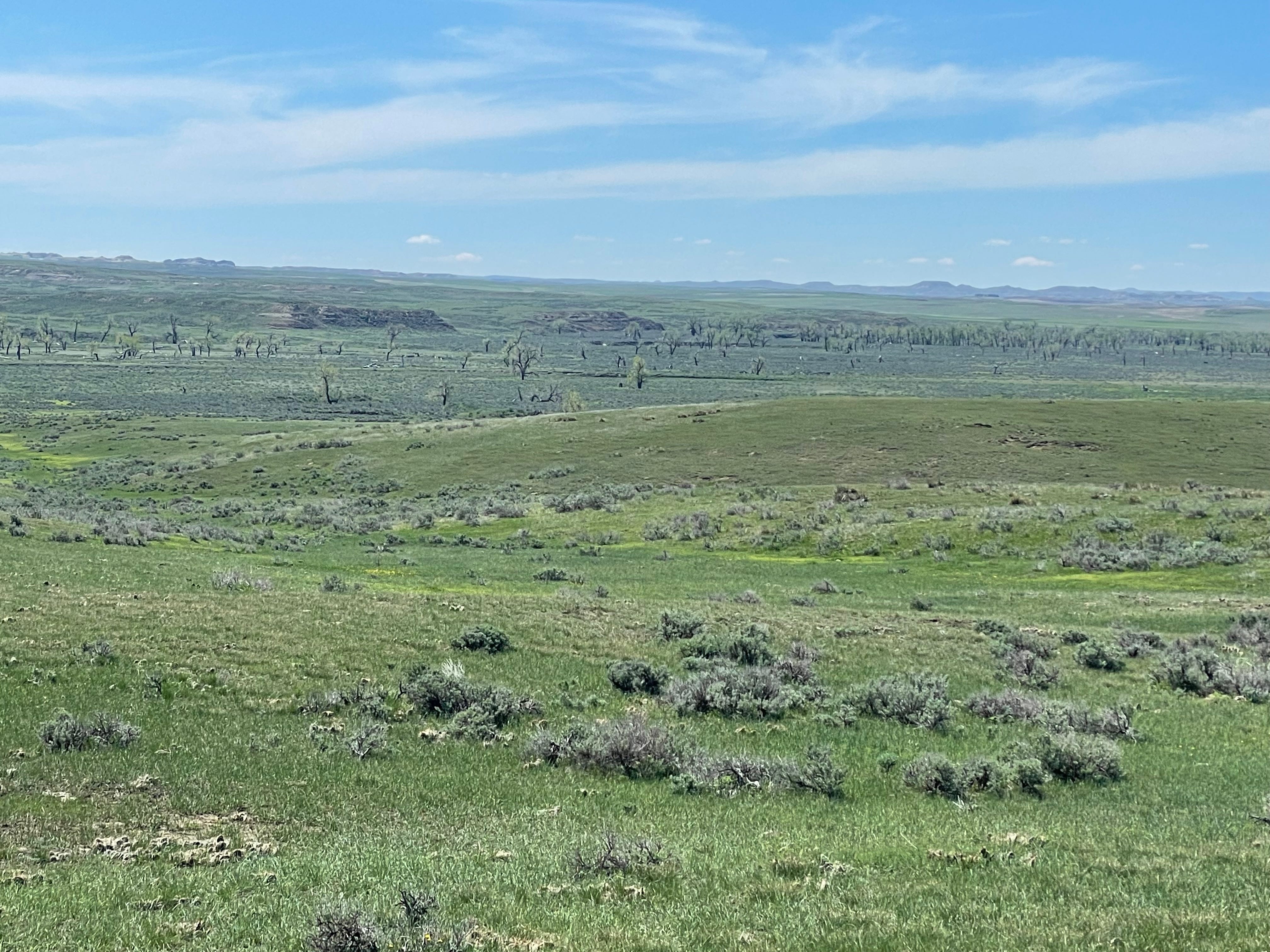
Western Montana grassland under chronic livestock grazing, with uniform low vegetation in the foreground and remnant cottonwood gallery forest skeletons in the distance—evidence of a once wetter, more structurally complex system.
The documentary everyone watches—and the documentary I watched
Most extinction does not look like a last individual dying in front of witnesses. It looks like absence going unnoticed.
The PBS/Nature documentary Willow: Diary of a Mountain Lion (built from a decade of noninvasive camera work) gives you everything you want from great wildlife storytelling: a female mountain lion, multiple litters, high-stakes hunting, den sites, fox pups, badger kits, bears, elk, deer—an entire living web captured without collars or spotlighting.
But the most important footage in this film isn’t what appears on screen.
It’s what never does.
A living experiment hiding in plain sight
The story takes place on MPG Ranch, a roughly 15,000-acre property in western Montana that now functions as a research and conservation landscape. It is important to be precise about what this place is—and what it is not.
This is not a pristine ecosystem.
It is roaded.
Portions were logged.
Much of the property was historically grazed, and some acreage was acquired from industrial timber ownership. Old-growth structure is largely absent. The forest bears the imprint of extraction and simplification stretching back more than a century. What the documentary shows is not recovery to some lost baseline, but the biological expression of a landscape long held below its potential.
That distinction matters.
If you’ve spent time in the rural West, you can feel the difference almost immediately—even if the film never names it explicitly:
No livestock. Vegetation is allowed to complete its life cycle. The ground is not continuously and repeatedly compacted. Soil structure, litter, and cover persist through seasons rather than being reset each year.
No hunting pressure within the study area. The film’s brief mention that Willow’s mother and sibling were shot on an adjacent property says everything about the surrounding matrix—and why animals concentrate here.
No wolves functioning as a dominant predator. That absence reshapes how cougars, coyotes, and prey partition space and risk.
You could call this “good habitat.”
But it is more precise to call it something else.
This is not restoration.
It is restraint.
What the camera traps capture indirectly—but never explain—is a quieter transformation happening below ground. Foxes carrying ground squirrels back to dens. Badgers digging and relocating soil. Mountain lion dens repeatedly used and abandoned. None of this restores the original ecosystem. Roads remain. Logging scars persist. Old-growth structure does not return. But something else does.
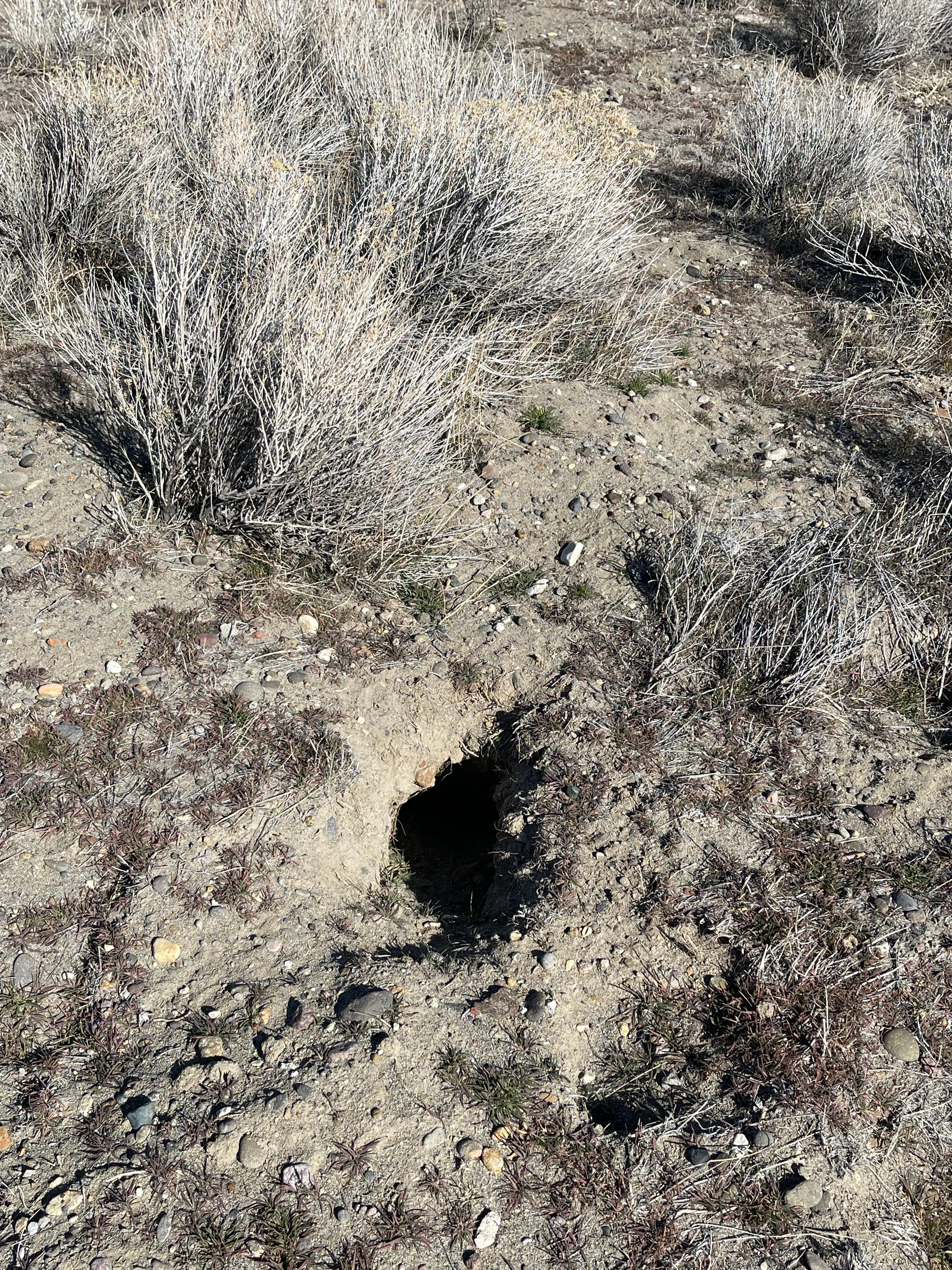
Entrance to a ground squirrel burrow in arid shrubland, with compacted soil, scattered stones, and low brush.
Below-ground complexity.
Even in degraded systems, burrowing animals reintroduce porosity, oxygen pathways, microbial habitat, and heterogeneity to soils long compacted by livestock and machinery. These are not cosmetic changes. They affect infiltration, nutrient cycling, seed survival, fungal networks, and the persistence of moisture through dry periods. Improvement does not require returning to a lost baseline. It requires releasing the organisms that still know how to do the work.
This is the part of “restoration” most people never see—because it doesn’t look like planting trees or moving animals. It looks like animals being allowed to move soil, carry prey, dig, abandon, return, and repeat.
A degraded ecosystem, released from constant pressure, is being allowed to biologically manifest itself as fully as it still can. And that turns out to be enough to reorganize abundance.
And islands don’t just protect animals.
They rearrange competition.
When chronic pressure is removed, competitive displacement plays out across all levels of the system. Plants regain structure. Small mammals reoccupy ground long denied cover. Predators respond not to management targets, but to prey actually present. What looks like resurgence is often redistribution—the same species expressing themselves differently once compression is lifted.
This is why the footage feels uncanny.
Not because the land is untouched—but because it is briefly unburdened.
Refuge effects: when safety concentrates life
In the 1980s, when I fenced riparian zones to exclude livestock, elk came from miles away. That part wasn’t surprising.
What surprised me was what happened next.
Small mammals exploded. You could read it in the grass itself—runways everywhere, as if someone had ridden a bicycle through the understory. Badgers moved in. Small predators followed. The whole lower food web surged when the ground layer came back.
That’s what I saw in Willow, except scaled up from riparian strips to an entire landscape.
This is the overlooked truth of “intactness” in the modern West: remove chronic grazing and constant human pressure, and the response isn’t subtle. It’s structural. And structure is what life builds on.
Small mammals: the missing engine
We tend to narrate ecosystems through their largest bodies—elk, bears, lions—because those are the animals we can see and film.
But the real engine is often smaller: the rodents, shrews, ground squirrels, voles, mice, and the insect world beneath them.
When vegetation structure returns, small mammals respond fast. When small mammals return, everything that feeds on them becomes possible: foxes, badgers, bobcats, raptors, weasels, snakes—plus higher carnivore success through increased prey diversity and resilience.
This matters for deep time, too.
Megafauna didn’t just “eat plants.” They created the stage’s architecture—soil texture and aeration, disturbance mosaics, nutrient movement, patchy vegetation, and the permeability of the landscape. When that architecture collapsed, it didn’t only change the fate of giant herbivores. It rewired the small stuff: the small mammals and insects that rarely fossilize and are almost never counted.
Small mammals are the last losses large enough to be noticed. Below them lies an almost total erasure of life we were never equipped to see.
What this ranch is—and what it isn’t
This isn’t “pre-contact nature.” It’s a modern, bounded system with a particular cocktail of rules.
A no-hunting, no-livestock refuge inside a broader landscape can become a magnet for elk and deer. That can inflate ungulate densities locally—sometimes far above what a fully wild, fully connected range would distribute across a larger area.
So I’m not claiming MPG Ranch is a perfect “control.” There are no perfect controls left.
But that’s exactly the point.
In the lower 48, we no longer compare “with grazing” to “without grazing.” We compare one kind of disturbance regime to another, and call it science.
And yet even in that compromised reality, this film shows something most Americans rarely see:
A landscape where the ground layer is allowed to exist—and an ecosystem that rises to meet it.
The uncomfortable takeaway
The removal of chronic pressure does not simply increase abundance; it reorganizes entire food webs in ways that cannot be cleanly predicted. Predator guilds reshuffle. Prey redistribute. Competitive hierarchies loosen and reform. What emerges is not a return to a known past, but a new expression of biological possibility constrained only by what remains. If cattle had been present, the food web the documentary captured would not exist at that density—perhaps not at all. If wolves had functioned as a dominant competitor, mountain lion dynamics would have shifted sharply. If hunting pressure had been constant, prey would not have used the property the same way. These are not management levers producing linear outcomes; they are boundary conditions that determine whether complexity can express itself at all.
That’s not an argument against ranchers, or hunters, or wolves.
It’s a reminder of the physics of pressure.
Add enough chronic pressure—hooves, fences, bullets, persecution, fragmentation—and ecosystems don’t always collapse dramatically. They simplify. They narrow. They run faster, with less buffering, less redundancy, and less capacity to hold on.
And that is what extinction usually looks like.
Not bodies.
Absences.
Coda: the richest conservation tool is restraint
MPG Ranch says it became a restoration and research property after its 2009 purchase and later expansion (including acreage acquired in 2016).
I don’t know what motivates every wealthy landowner. But I do know this:
If more money in the West bought restraint instead of extraction—if more landscapes were allowed to recover their structure—we would not have to romanticize “wilderness” as something only national parks can contain.
We would start seeing life again in the places we’ve trained ourselves not to look.
Note: This essay stands on its own. For readers who want additional context, it’s in conversation with the documentary Willow. Link: https://youtube.com/playlist?list=PLvxs_j5q540YuW6HuMDCKflA8CLgci65o&si=JWKczKTOzOZi8Dxe
Wise and informed work, Lyle. I have a ranch outside Augusta from which I removed all livestock 36 years ago and allowed no hunting since then. It has no roads and is in a conservation easement with FWP. Every form of life has come back. It’s not magic; it’s nature.
The ability to read the landscape in historical context is often both a pleasure and a sadness. Instead of just a walk in the woods one sees the youth of the trees, the remnants of agriculture, old cuts and burns, and the resulting new regime. However, the protected areas are examples of " Go easy on life and life will improve". The loss of biological history does not preclude the present start of a new history. Not yet.