The Human Exception

Environmental debates often become arguments over which single factor matters most. Some point to capitalism. Others blame consumerism, inequality, fossil fuels, industrialization, technology, government policy, or the lifestyles of wealthy nations. Still others argue that changing our diets or reducing consumption would allow Earth to sustainably support many more people.
Each contributes. But ecosystems rarely unravel because of a single cause. They respond to the combined effects of population, consumption, technology, economics, and countless interactions among them.
There is, however, one curious pattern that appears again and again. When another species becomes extraordinarily abundant, we readily recognize that its numbers can reshape an ecosystem. We may describe such pulses as excess or overshoot, even when they are part of a natural cycle of disturbance and recovery. When the discussion turns to humans, however, we often search for exceptions.
No organism illustrates this better than the locust. For millions of years, locusts have been among the most influential herbivores on Earth. Yet they receive little attention in discussions of ecosystem function. Ecologists are understandably drawn to charismatic predators and large mammals—wolves, elephants, whales, bison. Locusts are rarely celebrated as keystone species.
Most of the time, they remain almost invisible. Until they don’t.
When environmental conditions align, solitary insects transform into enormous swarms capable of consuming nearly everything in their path. Entire landscapes can change within days. Large concentrations of herbivores can dramatically alter landscapes. That observation carries no moral judgment. It is simply an ecological description.
No one finds this idea controversial. Interestingly, locusts themselves live remarkably simple lives. They eat plants. They make no clothing. They build no cities. They require no roads, automobiles, landfills, airports, data centers, or power plants. They generate no plastic waste, no nuclear waste, and no industrial emissions.
Yet when their numbers become sufficiently large, their collective ecological effects become impossible to ignore.
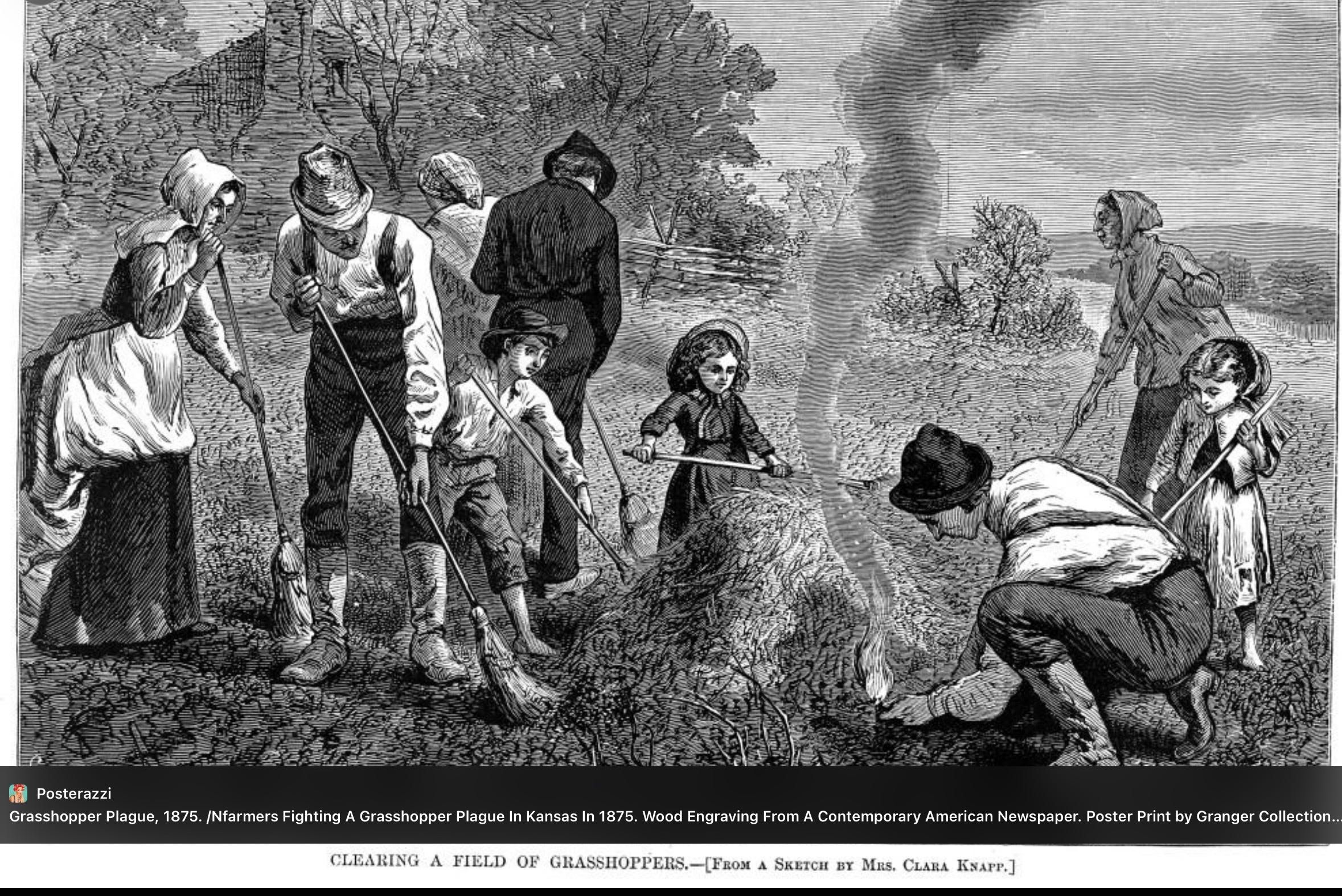
History provides a striking example. In 1875, the Rocky Mountain locust produced what is believed to have been the largest animal aggregation ever recorded. The swarm covered approximately 198,000 square miles—an area larger than many countries—and is estimated to have contained roughly 3.5 trillion insects.
The swarm was not a moral failure or even an ecological anomaly. It was part of the species’ natural ecology. Under the right environmental conditions, locust populations expanded dramatically, consumed vast amounts of vegetation, then collapsed again. The cycle had played out for millions of years.
The ecological effects of trillions of herbivores were obvious. That observation did not make each locust harmful or the swarm unnatural. It simply demonstrated that abundance influences the scale of ecological change.
Yet when humans become the species under discussion, our reasoning often changes. Human environmental impacts are frequently framed almost entirely in terms of economics, politics, technology, or patterns of consumption. These are all important, but they often obscure another reality.
Population determines the scale at which every other driver operates. A billion people and eight billion people can adopt identical lifestyles while producing profoundly different demands on land, water, energy, fisheries, forests, and biodiversity.
This is not an argument that population is the cause of environmental decline. It isn’t.
Nor is it an argument that consumption is unimportant. A relatively small number of people living highly consumptive lifestyles can have enormous impacts, while many communities live with comparatively modest ecological footprints.
The point is simpler. Ecological systems respond to total demand. Both the number of consumers and the demands of each consumer matter.
We readily accept this principle when discussing deer populations, rabbits on islands, bark beetles, sea urchins, algae blooms, or locust swarms. In those cases, we rarely insist that only one variable deserves attention.
Yet discussions about humans often become different. Population becomes politically uncomfortable. Consumption becomes ideological. Responsibility becomes something to assign rather than something to understand. The ecological principles themselves, however, do not change.
Perhaps this reflects something deeper than disagreement over environmental policy. Humans have always viewed themselves as exceptional. Throughout history, we have imagined ourselves outside the ordinary rules governing nature—set apart by intelligence, culture, technology, religion, or economics. But none of these exempts us from ecological relationships.
Like every other species, we depend upon finite landscapes, freshwater, soils, fisheries, and ecosystems with finite biological productivity. The laws governing those systems are indifferent to our politics, our philosophies, and our preferred explanations. Recognizing this does not require reducing every environmental problem to a question of population.
Nor does it require ignoring consumption, inequality, technology, or economics. It simply asks us to extend the same ecological reasoning to ourselves that we routinely apply to every other organism.
Ecological systems do not distinguish between organisms because of intelligence or intention. They respond to relationships, abundance, and demand.
Perhaps the greatest environmental exception we have ever invented is the belief that there should be one.
Thank you, Lyle -- extremely well written and reasoned.
Our multiplier problem is somehow very easy to see in other species, but not our own.
Indeed, it’s easy to blame billionaires for everything... and yet if we had zero billionaires almost all of our ecological problems and demands on nature would still be grossly unsustainable (not to let billionaires off the hook, their impact is of course obnoxious and unfair—but our numbers would be a problem even under perfect equality, so we really should acknowledge and internalize that so that we can work towards a smaller and more sustainable population, in addition to working on everything else).
Btw I think if wild animals could speak not one of them would doubt the fact that humans are overpopulated, or be confused or ambiguous about it, as our scale has meant their decimation.🐋🦓💚
You said it, brother.👍