

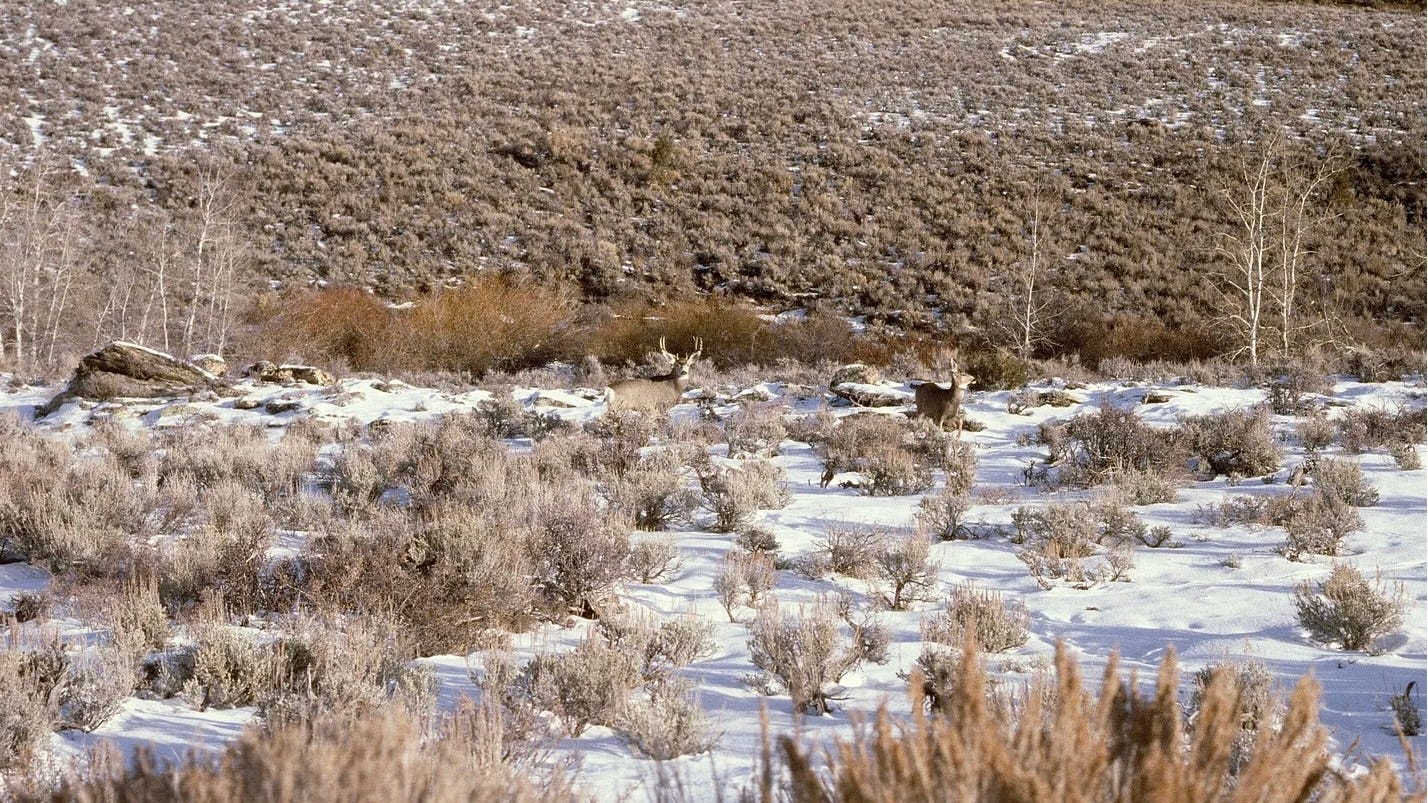
Late November on Wyoming winter range. Vulnerability begins with the landscape.
Few ideas in North American hunting are treated with greater reverence than fair chase. Most hunters know the phrase. Many organizations promote it. Wildlife agencies often invoke it as an ethical ideal.
But what exactly is it? The more I think about the term, the less certain I become that it describes anything objective at all.
It is easy enough to say that hunting should be fair. The difficulty begins when we ask: Fair to whom? Nature has never distributed vulnerability equally.
Some species evolved in landscapes where escape is relatively easy. Others survive by remaining nearly invisible. Some inhabit dense forests. Others live on open tundra. Some migrate through bottlenecks where thousands pass within a few days. Others are scattered across millions of acres.
Even within the same species, vulnerability changes constantly.
A drought can concentrate animals around a single water source. Snow can restrict movement or push animals into predictable locations. Migration can funnel them through narrow corridors. During the rut, normally cautious animals may abandon the behaviors that usually keep them alive.
Vulnerability is not a fixed property of an animal or a weapon but an emergent property of the entire ecological and human system.
The formal rules of the hunt may remain identical even as the actual fairness of the encounter changes dramatically. Some of the most coveted hunt permits offer access precisely when migration, rutting behavior, weather, or geography makes animals easiest to find and kill.
Wildlife agencies sometimes justify hunts during periods of heightened vulnerability by limiting them to so-called primitive weapons. The rationale would be more persuasive if the weapons were still primitive. Modern compound bows and muzzleloaders retain the names of older technologies while shedding many of their limitations. Precision sights, rangefinders, mechanical releases, improved projectiles, advanced propellants, and other innovations have made both categories far more effective than the labels suggest.
The result is a hunt timed for exceptional animal vulnerability and justified by a technological handicap that may no longer be much of a handicap. But this is only one example of a much broader pattern. As hunting technology advances, the boundary between an acceptable advantage and an excessive one continually moves.
Every generation redraws that line. Rifles replaced bows. Repeating rifles replaced single-shot weapons. Telescopic sights extended the distance at which an animal could be identified and killed. GPS units and satellite imagery made remote country easier to navigate. Trail cameras allowed hunters to monitor wildlife without being present. Thermal optics made body heat visible through darkness and vegetation. Long-range rifles and increasingly sophisticated ammunition now make shots possible at distances where an animal may have no awareness it is being hunted.
Archery has followed much the same path. Modern compound bows, precision sights, carbon arrows, and highly engineered broadheads have steadily reduced the uncertainty once associated with bowhunting. The weapon may still be called a bow, but the category now contains technologies that earlier generations would scarcely recognize.
Nor does the technological advantage end with the weapon. Lightweight shelters, insulated clothing, backpack stoves, satellite communication, digital mapping, off-road vehicles, and lightweight food allow hunters to travel farther, remain longer, and function in conditions that once limited human access. Two-way radios allow groups of hunters to coordinate their movements, report the location or direction of animals, and close off possible escape routes. These tools do not kill an animal directly, but they erode the protection once provided by remoteness, weather, cold, darkness, exhaustion, and the limits of human endurance.
Each development also removes some element of uncertainty. The hunter knows more, travels more efficiently, sees farther, stays longer, and reaches animals that were once protected by distance, terrain, weather, or unpredictability. Yet the ethical boundary rarely remains fixed. Technologies initially condemned as excessive often become ordinary once enough people adopt them. What one generation regards as an unfair advantage, the next may regard as standard equipment.
An identical set of equipment can produce radically different encounters. Technology that offers only a modest advantage against one species in one landscape may make another animal almost defenseless.
The advantage may also come from another person. On guided hunts, much of the knowledge, preparation, and difficulty can be transferred from the hunter to someone with far greater experience. Guides may scout the landscape, locate animals, interpret sign, establish camp, and position the client for a shot. The hunter may remain comfortable and relatively insulated from the difficulty that once limited access and success. Skill does not disappear from a guided hunt. It may simply belong mostly to the guide. None of this necessarily makes the hunt unethical, but it further complicates the idea that fair chase can be judged by the weapon in the hunter’s hands.
This is why fair chase is so difficult to define. If fairness depends partly on preserving unpredictability and the possibility of escape, then every tool must be judged by how much predictability it introduces. The answer cannot be found in the tool alone. A rangefinder used in dense forest may change little. The same rangefinder paired with a long-range rifle on open terrain may fundamentally alter the encounter. A trail camera placed along a general migration route is different from a network of cameras transmitting the location of a particular animal in real time.
Technology does not operate separately from the species or landscape. It interacts with them. Yet discussions of fair chase often reduce the question to lists of permitted equipment rather than asking how much realistic opportunity the animal had to detect danger, evade pursuit, or escape. Each innovation makes success a little more predictable, but every generation tends to accept the technologies it inherited while questioning those that follow.
Human management also changes the equation. Artificial water developments, food plots, prescribed burns, logging, agricultural fields, predator management, access roads, game farms, population objectives, and season timing all influence how vulnerable animals become. Fairness is shaped not only by the hunter and the equipment they carry, but also by the landscape we have already altered.
Human density changes the equation as well. A hunt involving one hunter across several square miles bears little resemblance to one involving dozens of hunters concentrated into the same landscape. Animals displaced by one hunter may move directly toward another as escape routes and refuges disappear. Even when every hunter follows the same rules and uses identical equipment, the cumulative pressure imposed on wildlife can differ enormously depending on how many people occupy the landscape. Permit numbers, season structure, road access, and hunting pressure all become part of the ethical equation.
The sequence of events matters as much as the technology. Pursuing a cougar or bear with hounds presents a different ethical question than shooting the same animal once it has been treed. The pursuit may involve difficulty and endurance for both hunter and animal. The final shot, however, occurs under circumstances where the animal’s options for escape may be extremely limited. Whether one regards that as acceptable or unacceptable, it illustrates a broader point: fairness cannot be judged by the hunting method alone. It depends on the specific circumstances of the encounter.
Wildlife agencies decide when animals may be hunted, how many permits are issued, which weapons and methods qualify, and whether seasons coincide with migration, rutting behavior, snow conditions, or other periods of heightened vulnerability. Hunters then operate within a system that has already declared those circumstances legitimate. In that sense, agencies may not define fair chase philosophically, but they define much of what it means in practice.
The boundary of fair chase keeps moving because it is not an ecological boundary.
It is a cultural—and increasingly administrative—one.
Perhaps that is the deeper issue.
Fair chase is often presented as though it were a universal principle embedded within nature itself. In reality, it is an attempt to apply a single ethical label to an activity that varies enormously across species, habitats, weather, seasons, technologies, and individual circumstances.
That does not make the concept worthless.
Ethics matter.
Restraint matters.
Respect for wildlife matters.
But reducing all of those ideas to two words may create an illusion of precision where none exists. Ecology rarely operates through absolutes.
Fair chase ultimately depends on vulnerability, and vulnerability is never fixed. It emerges from the interaction of the animal, the landscape, the weather, the season, the technology, and the people involved. Every animal arrives with a different history, different experience, and different opportunity to escape.
Aldo Leopold popularized the phrase thinking like a mountain. Fair chase describes hunting as viewed from within the institutions and traditions that govern it—but not necessarily from the mountain’s.
Ecology does not produce simple categories. Every hunt emerges from the interaction of landscape, weather, technology, behavior, experience, and chance. Fair chase remains a useful aspiration, but it cannot eliminate that complexity.
The mountain never sees only two words.
Excellent article. Modern sport hunters developed fair-chase ethics in part to distinguish themselves from commercial market hunters. Killing was no longer simply killing. It was framed as something requiring restraint, skill, discipline and character.
Also, fair chase is not a legally binding ethical standard. It is largely a voluntary code, defined and interpreted within the hunting community itself. So the question is not simply what counts as fair chase, but who gets to define fairness in the first place?
It’s interesting to compare hunting today with all the technologies and interventions and boundaries imposed by human barriers — many hunters after few animals — with the hunting described in Farley Mowat’s Sea of Slaughter, which I’m now reading, when it was many hunters after many animals, so many still left that hunters could take out 10’s of birds with one shot, sit behind a blind, drunk, and shoot out at the masses without requiring being able to see much if any at all, club flightless birds to death by the hundreds or thousands in just a few hours. Humans absolutely decimated the natural world 1500’s-mid 1800’s here in North America, til there were few left. Then we began inventing technology to make it easier to get the few that are left.
When there’s a lot, we take a lot. When there’s a little, we take it all… to quote you.