
Myth and Mirrors
What Wolves and Horses Reveal About Ourselves

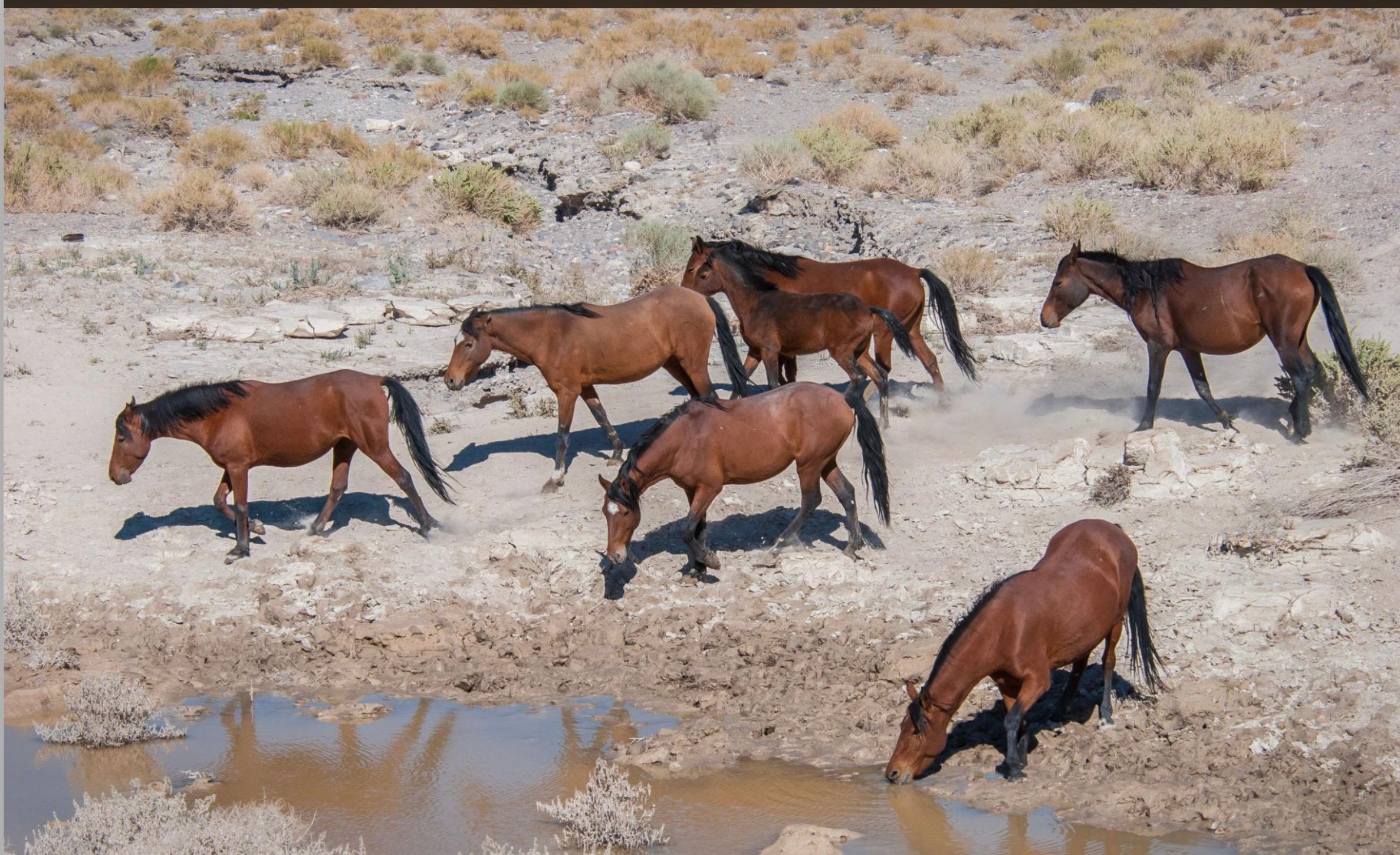
Wild horses at waterhole
Wolves were reluctantly returned to the western United States to restore ecological processes; horses were kept lovingly at the expense of them. Both reveal how human emotion shapes ecology—one through fear, the other through affection.
Ever a controversial animal, the ecological effects of wolf reintroduction remain debated. Scientists disagree about their magnitude and mechanisms, but few argue that wolves have been ecologically harmful. The same cannot be said for feral horses, whose effects on arid ecosystems are overwhelmingly negative and increasingly difficult to dispute.
That paradox sits at the center of western land management. We celebrate wolves for restoring ecological processes and lament wild horses for straining them, two charismatic species yoked to our values as much as to the landscapes they inhabit. The result is a mirror: what we protect or oppose often says more about us than about nature.
In the American West, this mirror reflects over four centuries of grazing, eradication, reintroduction, sentiment, and law. Wolves were absent from the western United States for seven decades; their return has generated controversy and intense emotional reactions from those who either hate or love them. Their effects on the landscape are uneven and contingent and scientists continue to debate their impact on ecosystem processes. What is rarely disputed is the direction of those effects. There is little evidence that wolves have had a negative influence on ecosystem function, even where the extent of their contribution remains contested.
Wild horses trace the opposite arc. Protected by landmark legislation and woven deep into national mythology, they concentrate around scarce water in drylands that never evolved under continuous, high-intensity equine pressure. Overdrawn, degraded rangelands have been shaped by unrelenting, pervasive cattle, sheep, and horse use. Unlike wolves, which disperse prey and movement across a landscape, feral horses—much like cattle—tend to linger at fragile springs and streams, trampling vegetation and churning them into mud holes.
Few animals have altered ecological processes on this continent in such unusual ways. Wolves did so through extirpation and reintroduction; horses through the extinction of native species and the arrival of a nonnative replacement. Both altered the land by vanishing and by coming back—but the horse’s second act reached farther and lasted longer, transforming nearly every ecosystem in western North America, and the mythology that once defined it.
The mythology surrounding wolves is every bit as powerful as that surrounding horses. For centuries wolves occupied a place in folklore not as animals but as symbols of danger. Little Red Riding Hood, The Three Little Pigs, and countless frontier stories portrayed them as cunning predators lurking beyond the edge of civilization. Across much of North America, fear of wolves became so deeply embedded in culture that exterminating them was viewed not as ecological management but as moral progress.
That mythology survived long after wolves themselves disappeared. In communities where wolves had been absent for generations, their return often triggered fears disconnected from measurable risk. Stories of children threatened at bus stops, livestock losses exaggerated into existential crises, and landscapes supposedly rendered unsafe by a handful of predators revealed how deeply the symbol persisted.
The horse followed the opposite path. Where wolves became vessels for fear, horses became vessels for longing. One was cast as the embodiment of wildness that threatened civilization; the other as the embodiment of freedom lost to it. Both stories say less about ecology than about ourselves. The wolf and the horse became mirrors reflecting the emotions we brought to the landscape, and management followed accordingly.
The horse people defend and the wolf people persecute is often not the animals themselves, but a cultural inheritance centuries in the making.
Horses and Wolves of Long Ago
Long before they were symbols of freedom or conquest, horses were part of North America’s original fabric. For millions of years they grazed the plains alongside camels, sloths, and mammoths, shaping the mosaic of grasslands and woodlands that defined the continent.
Two species—Scott’s horse and the Mexican horse—filled distinct ecological roles: one adapted to the open steppe, the other to wooded edges. Their disappearance, like that of mammoths and ground sloths, marked not just the loss of animals but the unraveling of an entire ecological order.
Ancient horses likely left a faint imprint compared with the giants they lived among. They were never abundant—minor players amid mammoths, mastodons, and giant bison that dominated the continent’s megafaunal biomass. Grasslands were probably shaped as much by insects as the ancient megafaunal assemblage routinely romanticized in popular literature.
The arrival of humans reshaped that equilibrium. As hominins spread across the continent, the ancient predator–prey balance unraveled. The extinction of horses, mammoths, dire wolves and giant bison opened ecological vacancies that smaller species like Bison bison and timber wolves—came to fill.
The “dwarf bison,” as paleontologists called it, and timber wolves thrived through retrenchment rather than grandeur: more fecund and better equipped to survive early hominid occupation than their larger kin. When horses returned, they did so in far greater numbers—restoring motion to the landscape, but a force ecosystems were ill-equipped to withstand.
What Returned
In 1519, Hernán Cortés brought Equus caballus to Mexico, and within two centuries their descendants had spread across the Southwest. What had vanished through evolution returned through empire. Horses multiplied, escaped, and entered Indigenous trade networks. Many nations rapidly adopted them, increasing mobility and hunting efficiency across the Great Plains.
Horses facilitated hunts, warfare, and migration while competing with the very bison that sustained those cultures. By the nineteenth century, free-roaming horse populations had exploded. Explorers described herds stretching to the horizon. In 1848, George Catlin wrote of “numerous bands of wild horses” on the plains; Ulysses S. Grant recalled a herd so vast it could not “all have been corralled in the state of Rhode Island.”
By 1930, most feral horses had vanished from the plains and retreated west of the Continental Divide. Their numbers, reduced by hunting and poisoned waterholes, fell to perhaps twenty-five thousand by the 1950s. Public outrage led to the 1959 “Wild Horse Annie Act” and later the 1971 Wild Free-Roaming Horses and Burros Act, granting federal protection. In the process, the distinction between North America’s extinct native horses and the modern descendants of European livestock gradually faded from public consciousness. The horse became not simply an animal, but a symbol—an embodiment of freedom, wildness, and the mythology of the American West.
We do not normally assume that an introduced species becomes native because a relative once occupied the continent. Few people would argue that modern camels restore the ecological role of the camelids that disappeared from North America thousands of years ago, or that African lions would be native because American lions once roamed the continent. Yet a similar argument is often made for modern horses.
Today roughly one hundred thousand feral horses roam public lands—far more than the Bureau of Land Management’s estimated ecological threshold of twenty-seven thousand.
Despite the Bureau’s deserved criticism for favoring ranching interests, its dilemma is real: it must enforce conflicting laws under inadequate funding. Adoption programs have faltered, urban demographics have shifted, and the cost of caring for captured horses now exceeds that of trained animals. What began as compassion has become a kind of purgatory, a Guantanamo of good intentions.
After seven decades of absence, wolves were reintroduced in Yellowstone National Park and Idaho in 1995 under the auspices of the Endangered Species Act. Abundant elk at the time resulted in wolf numbers quickly growing. As expected, elk numbers declined and wolf populations subsequently stabilized, creating a dynamic predator-prey relationship that persists today. That equilibrium, however, should not be confused with ecosystem recovery.
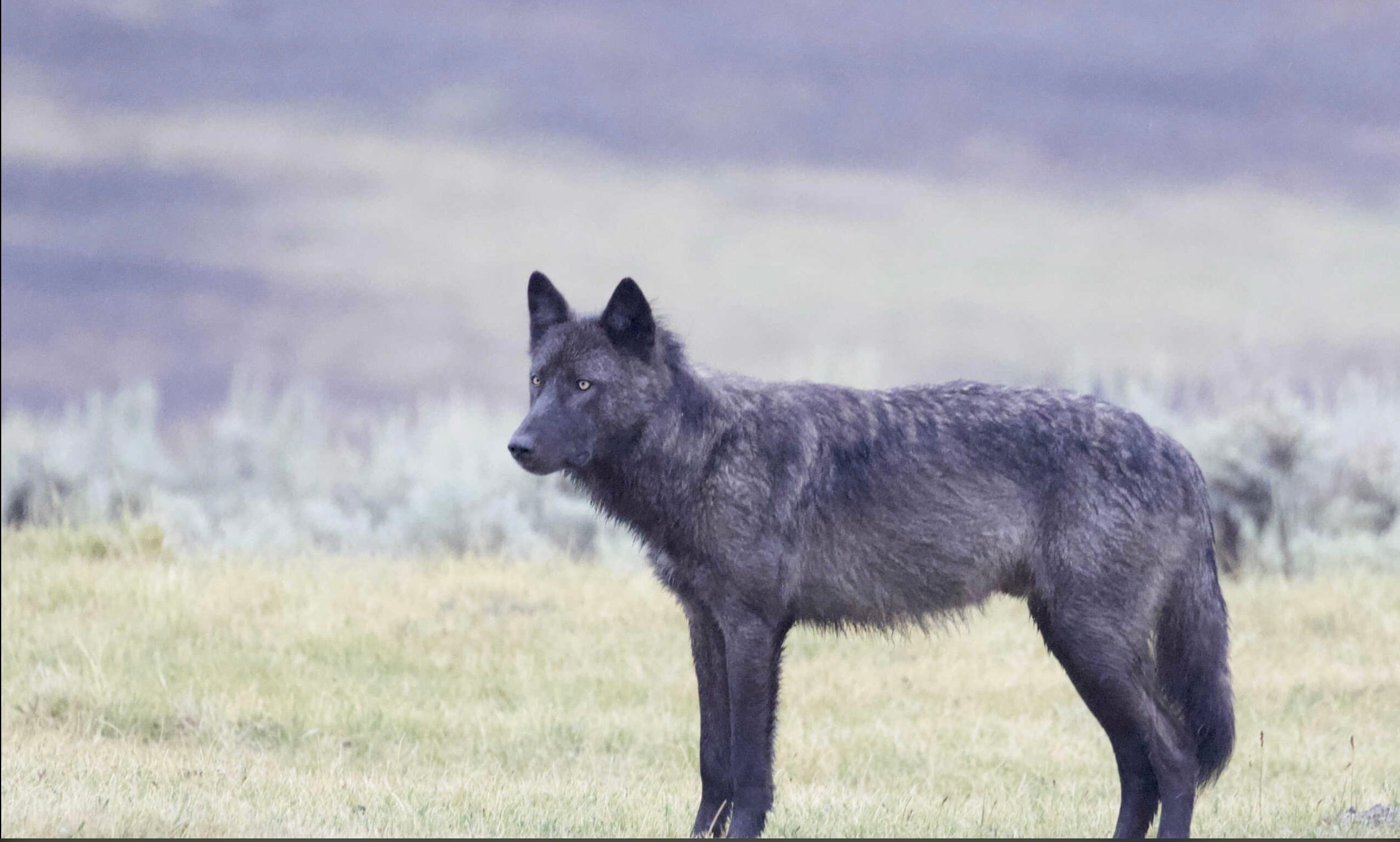
Throughout much of the West, wolf populations are managed as much through political tolerance and livestock conflicts as through prey availability. Whenever livestock predation occurs, individuals, and in many cases, entire wolf packs are lethally removed. Today more than 7,000 wolves occupy the western and upper Midwestern United States.
Mirrors
For the brief period of time between the megafaunal extinctions and Euro-American settlement, immense herds of buffalo were the hallmark of the Great Plains. West of the Continental Divide, buffalo were never present in large numbers. The degraded condition of today’s rangelands—erosion, topsoil loss, collapse of native plant and animal communities—is the legacy of a century and a half of relentless use by cattle, sheep, and, to a lesser extent, horses.
Ancient horses such as Scott’s horse and the Mexican horse evolved within ecosystems shaped by predators, competitors, and shifting forage. Their numbers remained relatively low, and their movements tracked seasonal changes in water and vegetation. Modern feral horses exist under very different conditions. Largely free from predation, they often congregate around scarce water sources—the most biologically productive habitats in arid landscapes—where repeated use can compact soils, strip vegetation, and degrade wetlands. Yet the ecological damage commonly attributed to wild horses rarely occurs in isolation. Across much of the West, horses share landscapes with cattle and sheep managed through grazing systems that have already altered vegetation, hardened soils, depleted water sources, and reduced biodiversity. In most places, the land was profoundly and permanently degraded long before feral horse populations became a focus of public debate.
Wolves were common across much of North America following the demise of the continent’s megafauna. That changed rapidly with European colonization. To many settlers, transforming a wilderness continent into a civilized society required the removal of wolves, buffalo, and Indigenous peoples alike. Wolves were viewed as obstacles to livestock production, settlement, and progress, and their eradication became part of a broader ecological, economic, and cultural project. They were removed not only from western landscapes, but from western identity.
Ironically, the zenith of wolf numbers may have coincided with the destruction of the buffalo. Slaughtering bison by the tens of thousands for their tongues and hides left incredible numbers of carcasses on the plains for several decades. Wolves took advantage of the bounty. However, as soon as buffalo numbers began to wane, hunters quickly switched targets and wolves were shot and poisoned in large numbers. By the mid-twentieth century wolves had been extirpated from most of the lower forty-eight states, surviving only in northern Minnesota.
The wild horse has become a vessel for our longing. The songs that celebrate its freedom—Wild Horses, Against the Wind—echo the freedom we imagine, not the wildness we’ve lost. The reality is less lyrical: their beauty masks a shared cost borne by the permanent loss of topsoil and native plants and animals struggling to survive. Movies about werewolves or casting wolves as dangerous human predators continually feed our fears about wilderness and all things wild.
Public-land ranchers and wild-horse advocates are twin heirs to the same mythology. Both draw from the romantic vision of the West—independence, endurance, freedom—but each defends a fiction. The rancher imagines stewardship through use; the advocate imagines freedom through preservation.
Horses and wolves have become opposite expressions of the same human tendency to project values onto animals and then mistake those projections for ecological reality.The irony is difficult to miss. The animal we fear most often disperses herbivory, restores predation, and increases ecological complexity. The animal we romanticize most often concentrates grazing pressure around the most fragile habitats in the West.
Myths
The myth of the wild horse endures because it disguises the fact that its survival—like our own—depends on intensive management and the degradation that sustains it. The myth of the wolf endures for the opposite reason. We turn a predator into a symbol of danger and imagine that removing it makes the world safer and more predictable than it really is. In that way, the wolf has become an emblem of the wildness we struggle to accept: a reminder that nature is not designed for our comfort.
Both have become symbols onto which we project our hopes and fears.
Their stories mirror our own. We mistake endurance for harmony, presence for belonging, control for security, and absence for peace.
Very interesting!! I live at the northern edge of the great basin, where wolves are dispersing and interacting with livestock. I also live surrounded by wild horse territory and have seen first hand what happens when the horse exists without a natural predator. Both creatures hold my imagination captive. When horses die of thirst and starvation, I feel sorrow. When wolves are shot on sight for being a wild, I feel sorrow.
Thanks for giving my imagination more fodder. I appreciate your craft of storytelling and look forward to your work!
Answer’s obvious per your piece, Lyle.
Reintroduce wolves to Nevada. I mean, U of Nevada Reno’s mascot IS the Wolves.
I assume wolves will hunt horses just like elk.
Problem solved.